Introduction
AI is different. Not because of the technology, remarkable as it is, but because of what buyers are actually purchasing.
In every previous era of enterprise technology, buyers were purchasing a tool. The business case mattered, but the tool itself was something they understood. They could specify it and evaluate competing versions against a reasonably clear set of criteria. The seller’s job was to present the tool persuasively, differentiate it from the alternatives, and negotiate the price. That was the playbook, and most of the time it worked.
AI buyers are not purchasing a tool. They are purchasing a transformation: a change in how their organisation operates, how their people work, and how they compete. There is no clear set of technical criteria to compare, because the thing being bought is not technical. That is a fundamentally different purchase decision, and it changes all three parts of your job.
Present AI. Executives do not need to understand the model. They need to see what changes in their business. You present the outcome, not the product.
Sell AI. A transformation is not won on features or price. It is won when the buyer can make a decision they are able to defend, so you sell the business impact, not the functionality.
Build AI. What you sold was an outcome, so that is what you have to deliver. The build is measured by the change it produces, not by the go-live date.
One idea runs through all three, and it is the compass for this playbook: the outcome comes first. It points you in the right direction every time: away from the product and towards the outcome; away from features and functions and towards business impact; away from the demonstration and towards the decision. Keep that compass in hand, and the rest of this playbook will make complete sense.
The Importance of the “Quick-Win Zone”
In AI projects, quick wins matter. They build momentum, and they let customers see real progress in weeks instead of waiting months for a first result. That early proof earns the trust and the budget for the bigger steps that follow.
A simple way to find them is to plot each use case on two axes: effort on the x-axis and ROI on the y-axis. Quick wins sit in the upper left corner, where effort is low and return is high. That is where an AI project should start.
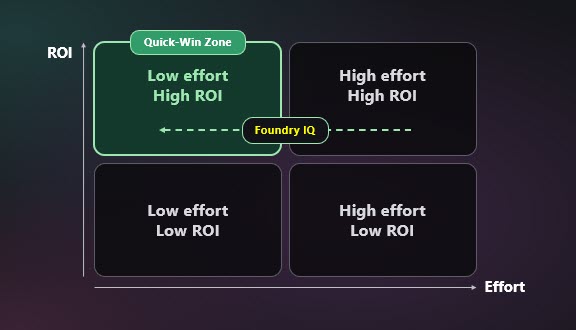
For example, a customer already has a semantic model in Microsoft Fabric and wants to create a Data Agent. The hard work of modelling the data is already done. What remains is preparing that data for AI consumption and launching a prototype in Microsoft Foundry for a small team to test. That can be done in a very short time, and the customer gets a working agent on their own data.
Return on AI (ROAI): Is Your AI Project Actually Worth It?
Every AI project comes with a price tag, but the real question is what you get back. That is what Return on AI (ROAI) measures: the value an AI project delivers compared with everything it costs to build and run.
The formula
ROAI = (Benefits − (Cost to Achieve + Cost to Maintain)) / (Cost to Achieve + Cost to Maintain) × 100
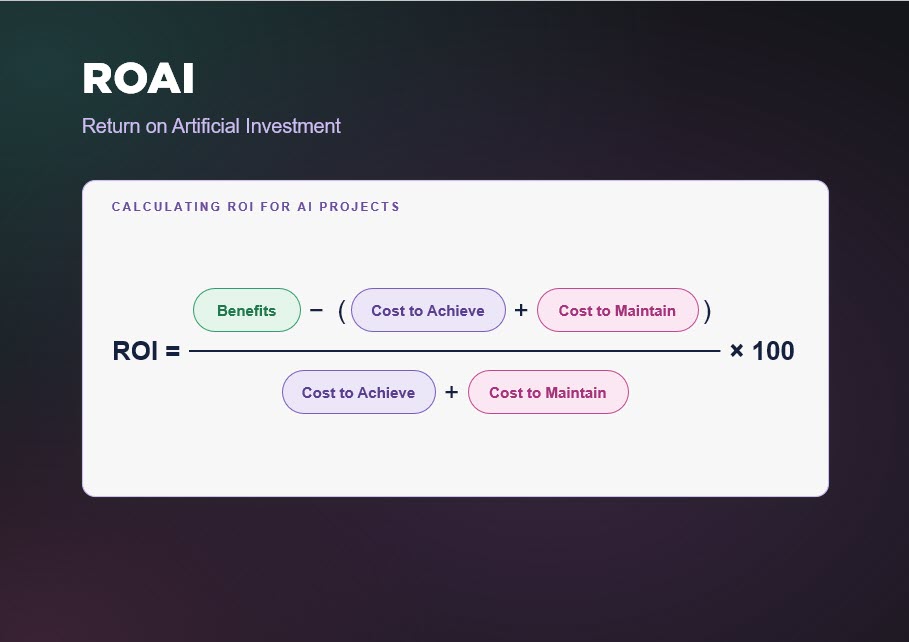
- Benefits: the value created, such as time saved, revenue gained, or errors avoided
- Cost to Achieve: what it takes to get the solution live (development, integration, training)
- Cost to Maintain: what it takes to keep it running (usage fees, monitoring, updates, human review)
An example
A company builds an AI assistant for its customer service team and looks at a three-year period:
- Cost to Achieve: CHF 200,000
- Cost to Maintain: CHF 100,000
- Benefits: CHF 450,000
ROAI = (450,000 − 300,000) / 300,000 × 100 = 50%
For every franc invested, the company gets its franc back plus 50 centimes.
How ROAI relates to TCO
Total Cost of Ownership (TCO) is the full cost of a solution over its lifetime. In the formula above, it is simply Cost to Achieve + Cost to Maintain: CHF 300,000 in our example.
TCO tells you what a project costs, and ROAI tells you whether it is worth it. You need the first to calculate the second, and an underestimated TCO makes ROAI look better than it is. With AI, it is usually the maintenance costs that get underestimated.
The takeaway
A cheap AI project with no measurable benefit is a bad investment, and an expensive one can be a great one. Start with an honest TCO, then judge the project by its ROAI.